Futures prop firms sell evaluations: you trade a simulated account, try to hit a profit target without breaking the rules, and, if you pass, move to a funded stage with payout rules of its own. The rules are where firms really differ: how the drawdown trails, whether there's a daily loss limit, how a consistency rule works, and what each stage costs.
This page explains those rules in plain English and puts seven firms' published rules side by side for one comparable plan. FundedReady is not a prop firm and doesn't rank or recommend firms. We're a free, account-free trading practice simulator. Every figure below is taken from the firm's own website or help center and dated. Prop firm rules change often, so always confirm on the firm's site before you buy.
Last checked: 14 October 2026.
How a futures prop evaluation works
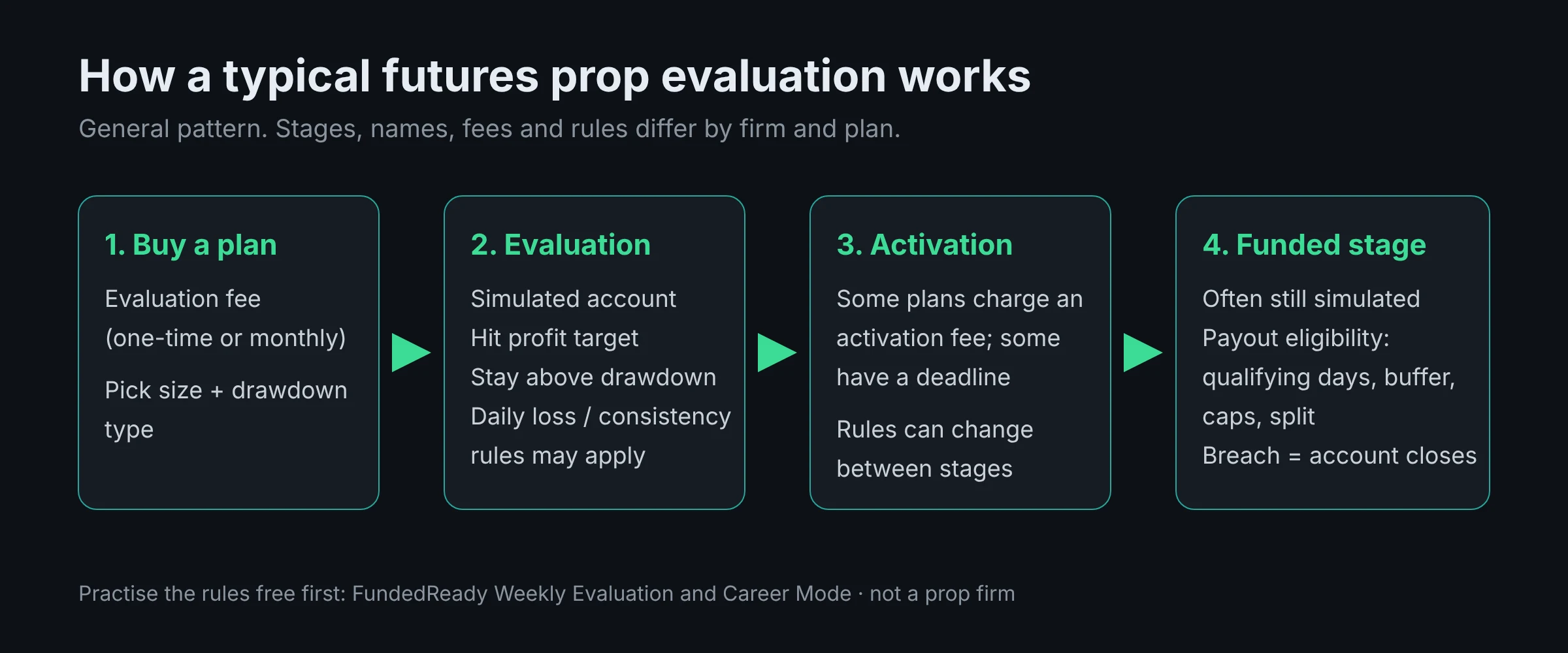
Most futures prop firms follow the same four steps:
- Choose a plan. You pick an account size (often $25K–$150K) and sometimes a drawdown type. You pay an evaluation fee. Depending on the firm it's one-time or a monthly subscription.
- Trade the evaluation. It's a simulated account. You need to reach a profit target (often around 6% of account size) while staying above a maximum loss level, and sometimes inside a daily loss limit, a consistency rule and a contract limit.
- Activate. Some plans charge an activation fee after you pass, and some set a deadline to pay it. Profits from the evaluation usually don't carry over.
- Trade the funded stage. This is often still a simulated account. Drawdown rules can change here, and payout requests have their own conditions: qualifying days, a buffer, caps and a profit split. Break the main loss rule and the account usually closes.
The detail differs by firm and plan, which is why a side-by-side of the actual rules matters more than a headline price.
The rules that decide most evaluations
Trailing drawdown: intraday vs end-of-day
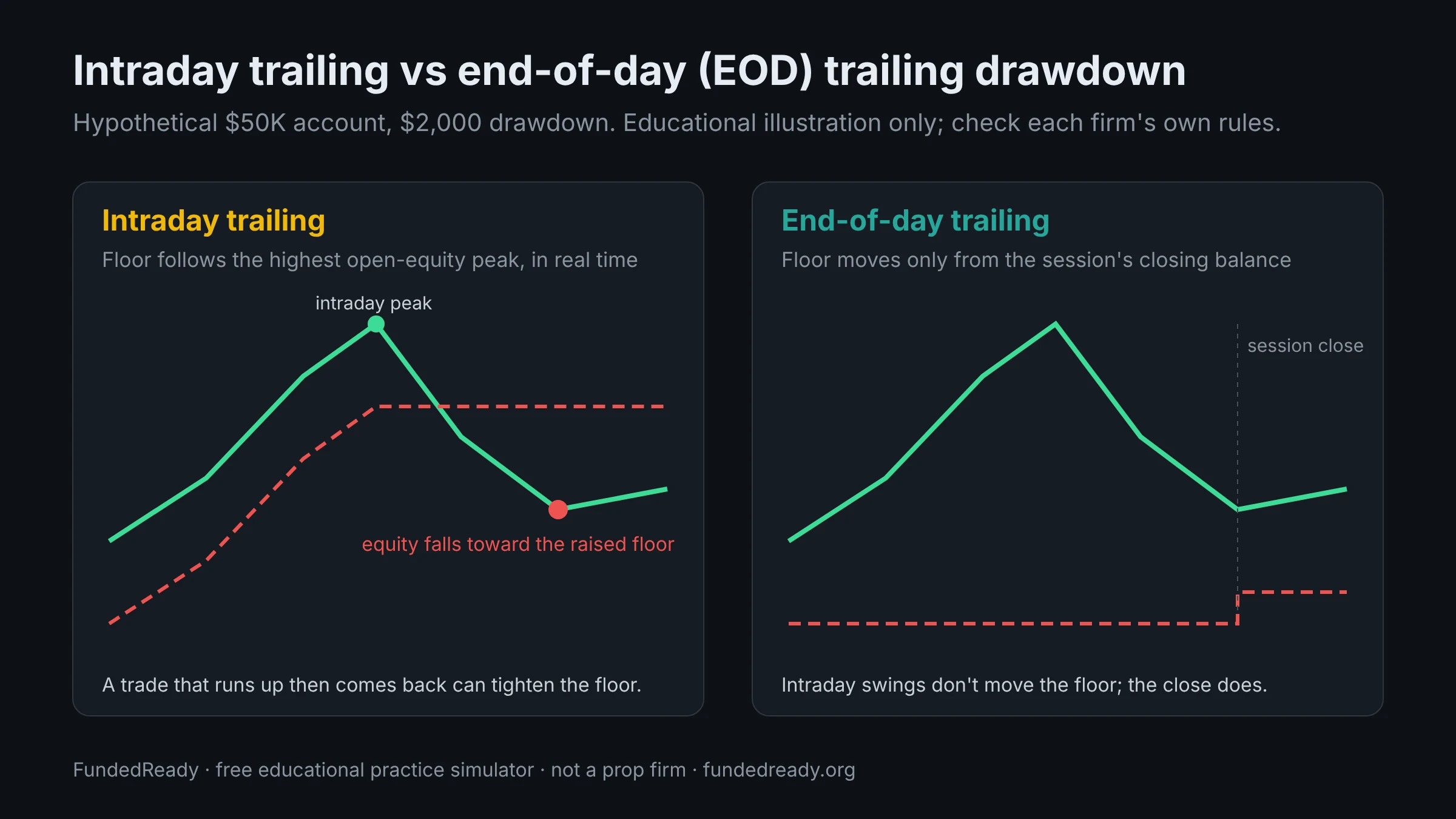
The maximum loss limit (also called max drawdown or MLL) is the lowest level your balance is allowed to reach. Most futures firms make it trail: as your account makes new highs, the floor moves up behind it, usually until it locks at a set level.
- Intraday trailing follows your highest open-equity peak in real time. A trade that runs up $800 and then comes back to breakeven can still raise your floor by $800.
- End-of-day (EOD) trailing moves the floor only from your closing balance, once per session. Intraday swings don't raise it. Some firms still enforce the limit against live, unrealised P&L during the day, though. Topstep, for example, says its limit "updates at the end of each trading day but is monitored in real time".
- Static drawdown doesn't trail at all. It's rarer in futures.
Hypothetical example: on a $50,000 account with a $2,000 EOD trailing limit, your floor starts at $48,000. Close a day at $50,500 and the floor rises to $48,500. Lose $500 the next day and the floor stays at $48,500. It never moves down.
Practise it: Static vs trailing drawdown practice · Trailing drawdown explained · Drawdown calculator
Daily loss limit
A daily loss limit (DLL) caps how much you can lose in one session. It comes in three flavours. A hard breach fails or closes the account. A soft pause stops you trading for the rest of the day but keeps the account open (MyFundedFutures describes its Builder DLL this way). None or optional means some plans let you choose at purchase, usually at a different price (LucidFlex works like this). Read which one your plan uses: the same number means very different things.
Practise it: Daily loss limit practice · Max daily loss explained
Consistency rules
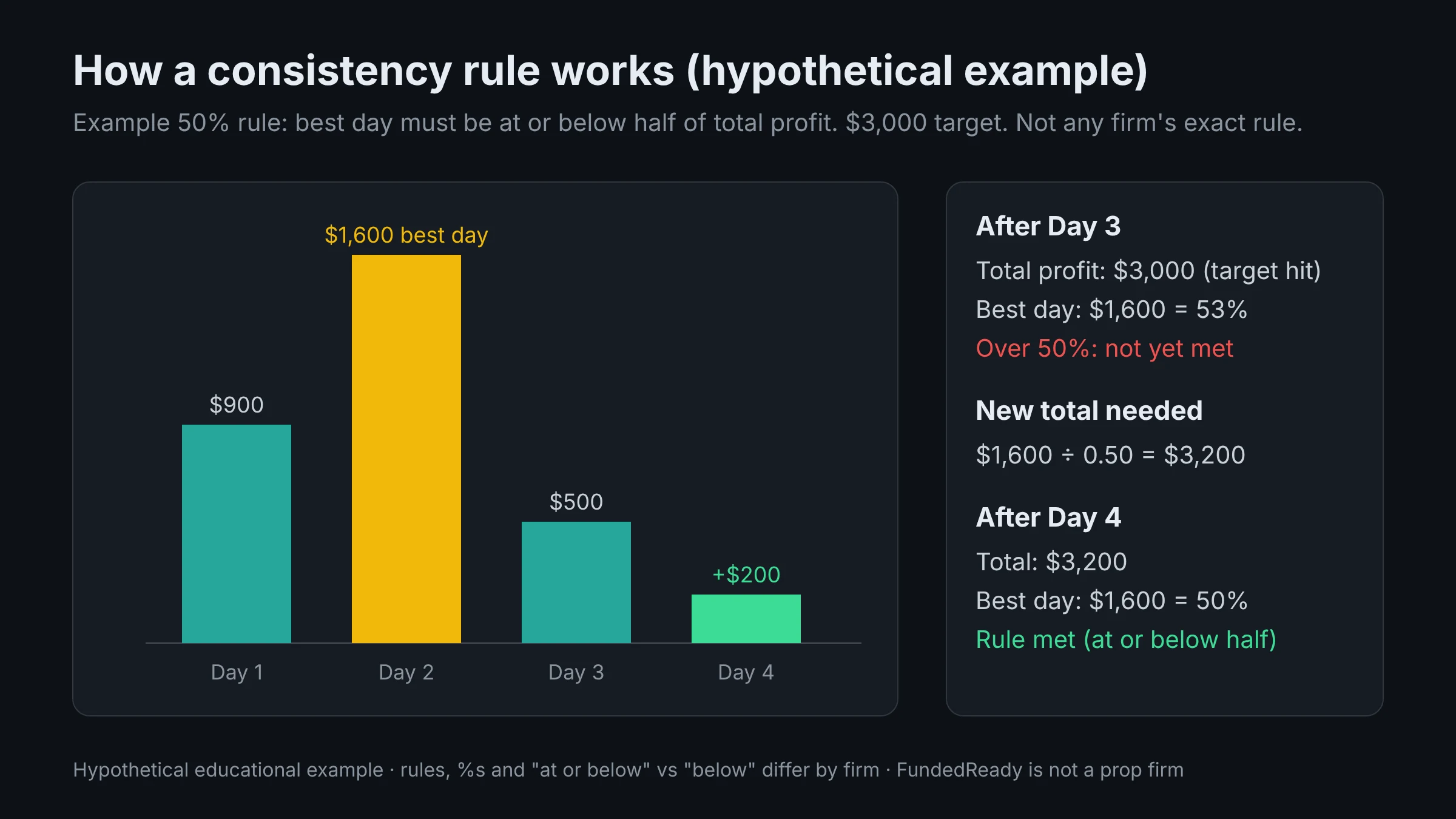
A consistency rule limits how much of your total profit can come from your single best day. Firms apply it differently. Topstep's Trading Combine uses 55%: if your best day goes over 55% of your profit, your profit target rises to best day ÷ 0.55, so the account isn't failed. Other plans use 30%–50%, apply it only at the evaluation or only at the funded stage, or have none.
Hypothetical example: with a $3,000 target and a 55% rule, a $1,800 best day lifts the target to about $3,273.
Practise it: Consistency rule practice · Consistency rule explained
Payout rules and profit splits
The headline split, often 80/20 or 90/10, is only one part. What usually decides when, and how much, you can request:
- Qualifying days: for example, five days that each reach a minimum profit.
- Buffer: a balance you must build above the starting level before your first request.
- Caps: a per-request maximum, often a percentage of profit up to a dollar limit.
- Lock effects: on some plans, requesting a payout locks or resets the drawdown floor, which can leave you less room.
Model hypothetical numbers with the payout rules calculator. Read more: Prop firm payout rules · Profit split explained
Fees: evaluation, monthly, reset and activation
Compare the total cost of the path, not the sticker price:
- One-time vs monthly. A monthly plan charges again every month until you pass. A one-time plan charges again only if you buy another attempt.
- Reset fee: what it costs to restart after a breach, if resets are offered.
- Activation fee: charged by some plans after you pass. Some firms sell a "no activation fee" version at a higher upfront price.
- Data or platform fees, which some plans add.
- Discounts change constantly. Treat any promotional price as temporary.
Estimate it: Challenge cost calculator · Activation fee explained
Futures prop firm rules compared (50K plans, checked 14 Oct 2026)
One comparable 50K plan per firm (alphabetical, not ranked), from the firm's own published rules. Firms run several plans with different rules, so this is not a full list or a ranking. Prices are left out on purpose: they change with promotions almost daily. Check them on the firm's site.
| Firm (plan shown) | Profit target | Max loss / type | Daily loss limit | Consistency | Funded-stage payout notes | Source (firm's own site) |
|---|---|---|---|---|---|---|
| Apex Trader Funding (50K EOD Evaluation, new products) | $3,000 | $2,000 EOD | $1,000 | Not applied in evaluation; 50% rule applies to payout requests in the EOD Performance Account | 30-day access; 7 calendar days to pay a one-time activation fee after passing (amount: See firm's site). 100% payout split; 5 qualifying days ($250+ each on 50K); min balance to request $52,600; min $500; max 6 payouts | Apex help 1 ↗Apex help 2 ↗Apex help 3 ↗ |
| FundedNext Futures (Flex 50K) | $2,500 | $1,500 EOD | None | 40% in challenge; none funded | Rewards after 5 days; max withdrawal $1,500; 95% reward share; reset fee $82.99; 3 minis / 30 micros; one-time fee, no activation fee | FundedNext site ↗ |
| Lucid Trading (LucidFlex 50K) | $3,000 | $2,000 EOD; locks at $50,100 once balance exceeds $52,100 (or when a payout is requested) | Optional, chosen at purchase; soft breach (locked out until next session) | 50% in evaluation; none funded | 90/10; 5 days meeting the minimum profit plus positive net profit per cycle; min request $500; max 50% of balance up to a size cap; up to 5 payouts, then moved live; no buffer; one-time fee, no activation fee | Lucid help 1 ↗Lucid help 2 ↗Lucid help 3 ↗Lucid help 4 ↗Lucid help 5 ↗ |
| MyFundedFutures (Builder 50K) | $3,000 | $2,000 EOD trailing ($1,500 add-on option) | $1,000 soft pause | None in evaluation; pass in as little as 1 day | Sim funded starts at $0; $2,100 buffer + $500 net profit before first request; 80/20; $2,000 cap; up to 5 sim payouts; no activation fees on any plan | MyFundedFutures help 1 ↗MyFundedFutures help 2 ↗ |
| Take Profit Trader (50K Test → PRO) | $3,000 | Test: $2,000 EOD trailing. PRO: trails intraday from peak balance, including unrealised P&L | No daily loss limit among the 6 core Test rules | Best day below 50% of net profit; minimum 3 trading days; exceeding it raises the profit goal | PRO: 80/20; requests from day one once balance reaches the $52,000 buffer. PRO+: EOD drawdown, 90/10, no buffer. Up to 5 funded accounts | Take Profit Trader help 1 ↗Take Profit Trader help 2 ↗Take Profit Trader help 3 ↗Take Profit Trader help 4 ↗Take Profit Trader help 5 ↗Take Profit Trader site ↗ |
| Topstep (50K Trading Combine) | $3,000 | $2,000; trails end-of-day balance, monitored in real time; locks at starting balance | No mandatory DLL in the Combine ("one rule": the Maximum Loss Limit) | 55% best-day target; exceeding it raises the target | Express Funded: 90/10 split; Standard path 5 winning days of $150+, or Consistency path 3 days at 40%; max payout 50% of balance up to a cap; min $125; MLL set to $0 after first payout. Combine is a monthly subscription | Topstep help 1 ↗Topstep help 2 ↗Topstep help 3 ↗Topstep help 4 ↗Topstep help 5 ↗Topstep help 6 ↗ |
| Tradeify (Select 50K Evaluation) | $3,000 | $2,000 EOD trailing, enforced in real time | None in evaluation | 40% (50% add-on available); minimum 3 days | Choose Select Flex (5-day) or Select Daily payout policy after passing; Select Daily funded has a $1,000 DLL; no activation fees. Split: homepage says "Keep 90%" (plan-level split: See firm's site) | Tradeify help 1 ↗Tradeify help 2 ↗Tradeify help 3 ↗Tradeify site ↗ |
Rules change often. This table records what each firm published on 14 Oct 2026, read from the URL shown. It isn't advice, an endorsement or a ranking, and it says nothing about anyone's chance of passing or being paid. Always read the current rules on the firm's own site before you buy.
How to choose a plan (checklist, not a ranking)
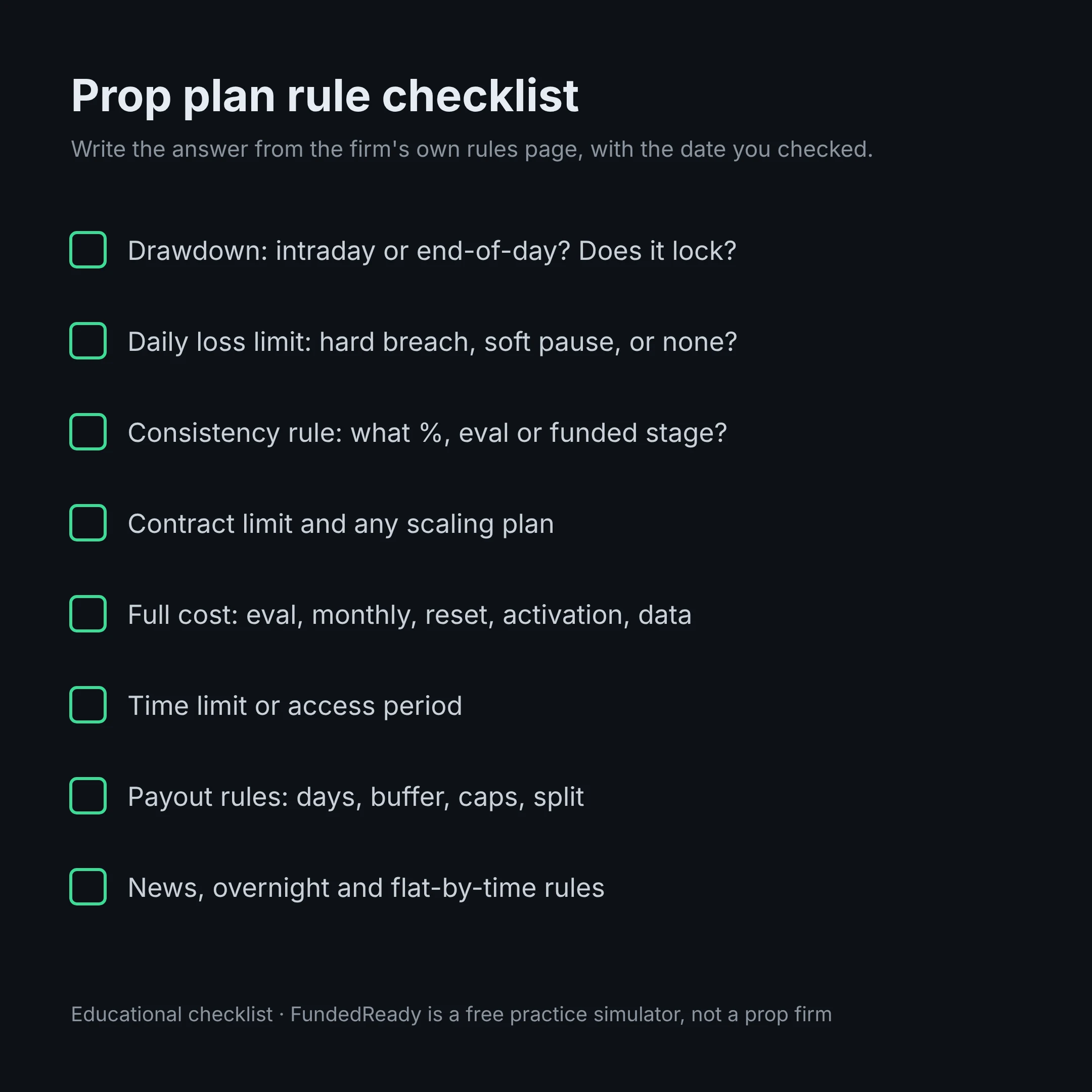
There's no single "best" prop firm. There's the plan whose rules fit how you trade. For each plan you're considering, write down the answer from the firm's own rules page, with the date:
- Market and platform: is it exchange-traded futures (not CFDs)? Which platforms and data feeds?
- Drawdown: intraday or EOD trailing? Where does it lock? Does it change between evaluation and funded?
- Daily loss limit: hard breach, soft pause, optional or none?
- Consistency: what percentage, at which stage, and what happens if you exceed it?
- Contract limit and scaling: how many minis or micros, and does that grow with balance?
- Time and session rules: access period, flat-by time, news, overnight and weekend holds.
- Total cost: evaluation (one-time or monthly), resets, activation, data.
- Payout conditions: qualifying days, buffer, per-request caps, split, number of payouts.
- Fit test: does your normal trading day (number of trades, typical loss, best-day size) sit comfortably inside these rules?
Use the prop firm comparison checklist and the rule checklist to record your answers.
Common ways traders fail evaluations
- Not knowing the drawdown type. On intraday trailing, giving back open profit raises the floor. Traders who think in closed P&L get caught.
- Trading the daily loss limit, not a plan. Hitting the DLL is often the end of a day spent revenge trading, not the result of one bad trade.
- One huge day. A big day can break a consistency rule and push the target further away.
- Oversizing to "pass faster". Max contracts aren't a target. Bigger size shrinks the number of losing trades you can survive.
- Ignoring stage changes. The funded stage can have different drawdown, buffer and payout rules from the evaluation.
- Time and session rules. Holding past a flat-by time, trading restricted news, or running out an access period.
- Resetting on tilt. Buying another attempt right after a breach, without changing anything.
Read more: Why traders blow up prop firm accounts · Prop firm drawdown mistakes · Prop firm failure diagnosis
Practise these rules free on FundedReady
FundedReady is a free practice simulator with no account needed: 15 courses, 75 levels and several game modes. It doesn't sell evaluations, and a FundedReady score isn't a prediction of how you'd do at any firm. It's a cheap place to make your rule mistakes.
- Weekly Evaluation: manage risk across a series of trades within a simulated evaluation. How it works
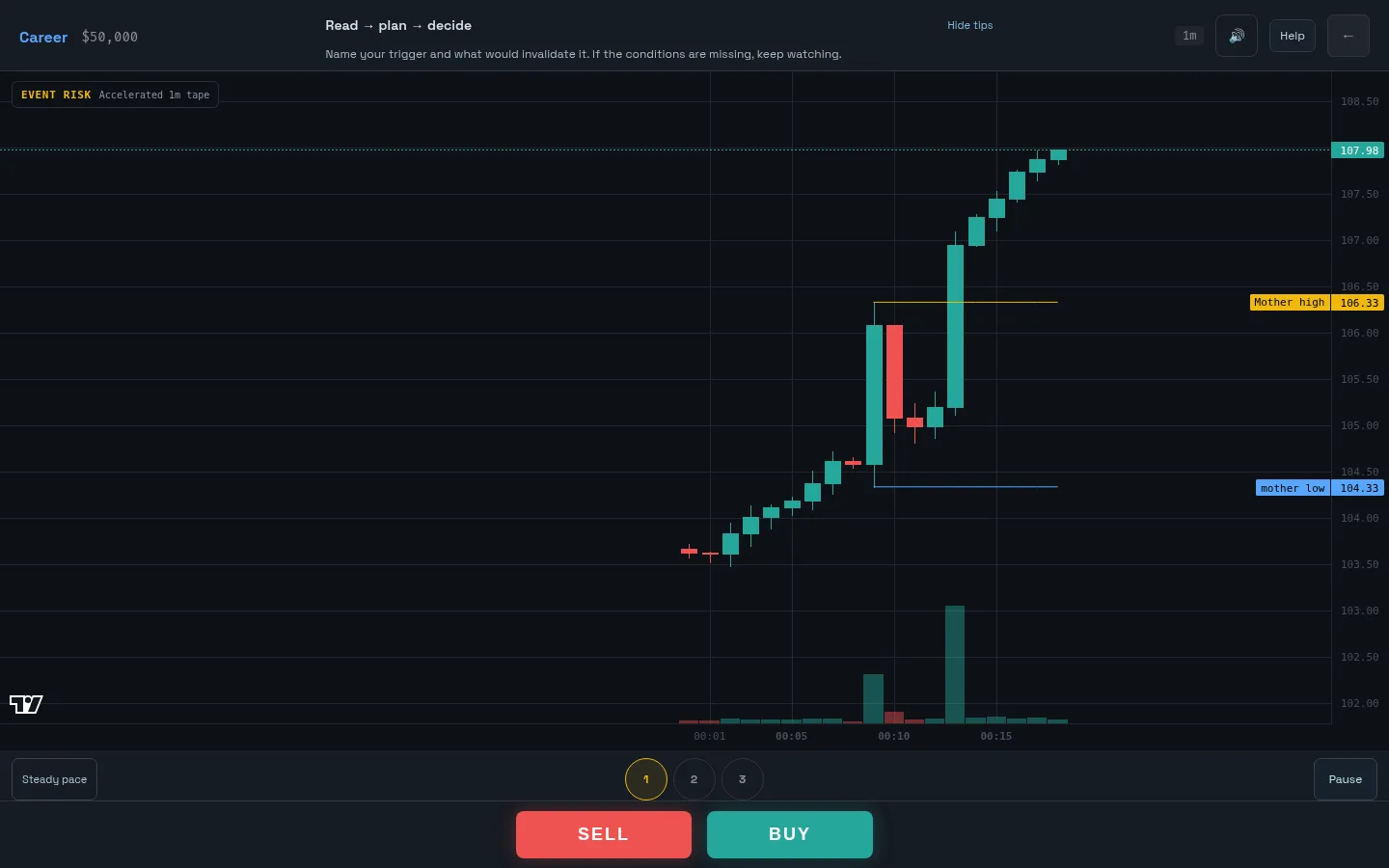
- Career Mode: see how position size and repeated decisions affect a virtual account. Career Mode guide
- Tilt Simulator: notice the urge to chase or win back a loss, and practise standing aside. Tilt guide
- Risk decisions in Decision Arcade: position size, stop distance and the loss your plan allows.
- Setups futures traders use, as free courses: Opening Range Breakout, VWAP Bounce, Bull Flag, MACD (histogram recovery plus price break), Scaling Into Winners.
- Rule drills: daily loss limit, consistency rule, static vs trailing drawdown, after a reset.
FAQ
Is FundedReady a prop firm?
No. FundedReady is a free, account-free educational trading practice simulator. We don't sell evaluations or funded accounts, and we don't rank or recommend prop firms.
What is a futures prop firm?
A futures prop firm sells evaluations on simulated accounts. If you reach a profit target while following its risk rules, you move to a funded stage with its own payout rules. Rules, fees and stages differ by firm and plan.
What is the difference between intraday and end-of-day trailing drawdown?
Intraday trailing drawdown follows your highest open-equity peak in real time, so giving back open profit raises your floor. End-of-day trailing drawdown moves the floor only from your closing balance once per session. Check how each firm enforces it during the day.
What is a consistency rule?
A consistency rule limits how much of your total profit can come from your single best day. Depending on the plan, going over it can raise your profit target, delay a payout, or not apply at all.
Which prop firm is best?
There is no single best firm. Compare each plan's drawdown type, daily loss limit, consistency rule, total cost and payout conditions against how you actually trade, using the firm's own current rules.
How often do prop firm rules change?
Often, sometimes several times a year, with new and legacy plans running side by side. This page shows rules as published on 14 October 2026. Always confirm on the firm's own site before you buy.
Can I practise prop firm rules for free?
Yes. FundedReady's Weekly Evaluation, Career Mode, Tilt Simulator and rule drills let you practise drawdown, daily loss and consistency decisions free, with no account. Practice results do not predict results at any firm.
Does FundedReady earn commissions from prop firms?
FundedReady may earn a commission through provider links on this page, at no extra cost to the trader. A commercial relationship does not establish suitability or guarantee a pass or payout. See our affiliate disclosure.